Start with the deaths.
Victor printed a Pentaborg. Two parts, grey PLA, screwed together, about the size of a plum. The question is whether that becomes a shippable robot, and for whom. The honest way in is backwards: the social robot category has killed companies with a hundred times his funding. Nothing gets recommended here until we know exactly how they died.
01 The graveyard
Every one of these died the same death, wearing different clothes
Not one died of bad engineering. Jibo and Anki built genuinely beautiful things. They died because the object cost more than the job it did was worth to the person paying, and because consumer robotics needs each funding round to be several times the last. Anki is the frightening one: it sold 6.5 million devices and still shut down in a single day.
What it forbids: treating unit sales as proof of viability. Selling well and being solvent are different things. A character robot's cost base is a games studio wearing a factory, and five distinct Pentaborg personalities is exactly that kind of content cost.
Sources: The Robot Report, 2019; IEEE Spectrum, 2019.
What it forbids: any design where Victor's ability to keep paying a hosting bill in 2031 is a product feature. The more emotionally effective the product, the larger the liability on shutdown. This kills the 2023 ideation note's ESP32-with-camera-and-WiFi concept outright.
Sources: Axios, Dec 2024; OECD.AI incident record 2024-12-09-ab89; AppleInsider, Dec 2024. Funding total is disputed: CB Insights records USD 68.8m over 9 rounds, another aggregator USD 86.3m over 7. No primary filing was opened, so treat the figure as unresolved.
What it forbids: a talking Pentaborg that answers questions is a worse ChatGPT with a battery. Any surviving version has to do something where being a physical object in a room with people is structurally the point.
Sources: TechCrunch, 2019; The Robot Report, 2019.
What it forbids: the belief that sufficient emotional attachment eventually fixes the economics. It does not. It never has.
Sources: Japan Times / AFP, 26 June 2026; TechXplore, 2026.
What it permits, oddly: this is the entry that makes a small ambition rational. The category cannot clear a multinational's hurdle rate. A product selling 400 units a year at real margin is a failure for Bosch and a meaningful outcome for one person in Mayo.
Sources: Engadget, 2018; The Robot Report, 2018.
- Reach Robotics, MekaMon (Bristol, closed Sept 2019). AR battle robot at around GBP 300. Its CEO: "the consumer robotics sector is an inherently challenging space". Novelty exhaustion: AR battling is a two-week experience on a cost base built for years. Note the escape hatch it reached for was education, the same direction Sphero took.
- Keecker (France, closed 2019, roughly USD 8m raised). A rolling home projector-robot. BOM cost with no defensible job: a projector on wheels competes with an EUR 80 projector on a table.
- Misty Robotics (Sphero spin-out, acquired by Furhat Jan 2022). "Developer platform" is not a consumer market. Misty sold a robot to people who would build the app that made it worth owning. Nobody did, at scale.
- Amazon Astro for Business (killed Sept 2024, under a year after launch). Even trillion-dollar balance sheets brick mobile robots when the unit economics do not close. Amazon at least offered refunds.
Sources: TechCrunch 2019 and 2022; The Robot Report 2019; TechCrunch July 2024.
02 The survivors
The one number that reframes the whole venture
Tonies did EUR 630m of revenue in FY2025. The Toniebox itself was EUR 161m of it. Roughly 74% of the money is the content figurines people choose to buy afterwards. There is no LLM, no cloud personality, no subscription lock, and the box works offline once content is loaded.
The 5i framework is natively a content system. Twenty-five specialisations is twenty-five blades for one razor.
FY2025 group revenue EUR 630m, up 31% (36% constant currency). North America EUR 276m (+40%), DACH EUR 214m (+16%), rest of world EUR 141m (+68%). Adjusted EBITDA margin 8.6%, above guidance. FY2026 guidance is above EUR 760m at 9 to 11% EBITDA.
Hardware is roughly 26% of revenue. The box is a razor and the figurines are the blades. "A companion" killed six companies on this page. "Plays the story on the figurine you put on it" built a EUR 630m business.
Source: tonies SE FY2025 results release. Every sub-figure was independently re-checked. One related claim, "over 9.5m Tonieboxes sold since 2016", could not be confirmed in the release text and is marked unverified.
Tokyo. Qoobo, the headless cat-tail cushion, took 5,000-plus preorders. Nekojita FuFu is a JPY 3,800 (around USD 25) robot that blows on your hot drink to cool it. Mirumi is around USD 70 and peeks shyly out of your bag. Each is crowdfunded before tooling, has no cloud, no account, and no ongoing service obligation.
This is the closest thing in the entire research set to a shape one person can actually operate. Small, cheap, opinionated, finished. Ship it, and it stays shipped.
Sources: Dezeen, Jan 2025; TechCrunch, Jan 2025.
- Miko (Mumbai). Revenue INR 358 crore in FY24, roughly EUR 39m, up 58%. From USD 199 in the US plus a USD 99/year content subscription. The counter-example to Jibo: same category, a quarter of the price, content library rather than personality as the value. A reported USD 155m Series D at USD 550m post-money was covered in Aug 2025 as being raised by board resolution, not confirmed closed.
- LOVOT (Groove X, Tokyo). Fewer than 20,000 units since 2019 at around JPY 349,000. Net loss JPY 2.7bn in FY2023, cumulative losses JPY 8.5bn. But 90% daily active users past 1,000 days and 60+ minutes of interaction a day. Read that carefully: the best retention in the category, still deeply loss-making. This is the strongest single argument against building an emotional companion. Single-source (KrASIA); Groove X is private and files nothing.
- Petoi (US). 30,000+ robots to 60+ countries, used in K-12, camps and university labs including Carnegie Mellon. Open source, no cloud, no personality promise. Nothing to brick.
- Tamagotchi (Bandai). 100 million units since 1996, milestone confirmed Aug 2025. A sub-USD 30 object with no motors, no cloud, no LLM, that produces care-and-attachment through software alone. The cheapest way ever found to create the emotional effect this whole category chases.
- UBTECH (HK: 9880). 2025 revenue above RMB 2bn (+53.3%), net loss RMB 789.8m, narrowed 32%. Humanoid segment revenue up 2,203.7% to RMB 821m; 1,079 humanoid units sold across the segment. It abandoned consumer and went industrial B2B. It started with consumer humanoids and toy kits; it now sells factory humanoids to carmakers. Consumer was the wrong end.
- Sphero. Deliberately exited Disney and Star Wars licensing to sell its own robots into schools. The licensing cliff was the danger and it jumped before it. BB-8 sold on a film release; a film release expires. Curriculum does not. Revenue figures circulating for Sphero are aggregator estimates and should not be quoted.
03 The five laws the graveyard writes
Every survivor has at least four of these five. Every corpse lacked at least three. This is the test any Pentaborgs product has to pass before it deserves a single euro.
Toniebox plays loaded content offline. Tamagotchi has no server. Petoi is open source. Yukai's objects have no account. Jibo, Moxie and Astro all bricked.
Not "we will open-source it if we fail". Designed from day one so the core value survives fiveinnolabs ceasing to exist. For a solo founder this is not a nice-to-have, it is the price of being taken seriously by anyone who read about Moxie.
Tonies: EUR 161m hardware inside EUR 630m total. Miko: USD 99/year for a library you opt into. The dead either had no recurring revenue at all (Jibo, Kuri, MekaMon) or made the subscription a hostage arrangement (Moxie).
The 5i asset is unusually well shaped for this. Five types, 25 specialisations. A magnetic five-piece set where the innovator types physically join is a razor with a collection mechanic built into the framework, and it needs no electronics at all.
Sphero, Petoi, Elephant Robotics and Wonder Workshop all sell to schools on budget cycles. Every dead company in section 01 sold a companion to a curious individual.
Victor already stands inside one of these channels. His EU AI Act Article 4 corporate training clients buy on a training budget, from someone who will run the workshop again next quarter. He does not have to build the channel, which is the single rarest asset on this page.
Dead: Jibo USD 899, Kuri USD 700, Moxie USD 799, Keecker. Alive: Miko USD 199, Ropet USD 299, Tamagotchi under USD 30, Yukai USD 25 to 70. LOVOT at roughly USD 3,100 survives only on venture capital and loses money doing it.
Note what this does to the maths: a 50mm figure priced under EUR 250 cannot carry servos, a speaker chamber and a certification file. The price cap and the ambition ladder are the same constraint seen from two sides.
If the answer to "what does it do" needs a second sentence, the category history says it dies. The test is whether a buyer can repeat the product's function to a colleague accurately, having heard it once.
04 The 2025-26 AI toy wave, and the trap with Victor's name on it
By October 2025 more than 1,500 Chinese companies had entered the AI companion toy category. Then US PIRG's Trouble in Toyland 2025 tested them. FoloToy's Kumma bear, running GPT-4o, told children where to find knives, pills and matches and how to light them, and discussed sexual content.
In order, what followed: FoloToy suspended sales, then returned the product to market days later. OpenAI suspended the developer, which is the critical commercial fact: your model provider can terminate your product with one enforcement action, at any time, with no notice. The US CPSC told Congress it is "neither equipped nor authorized" to evaluate emotional or psychological harm. Maryland enacted an AI Toy Safety Act. A bipartisan federal bill (S.5171) cleared Senate Commerce Committee, though note it is a study-and-report bill, not a regulatory statute. The FTC opened an inquiry.
Regulatory cost in this category is now rising faster than differentiation is available. Separately: every market-size figure for smart toys should be discarded. Two vendors describe the same 2025 category as USD 8.55bn and USD 42.15bn. A 5x disagreement on the current year means nobody knows.
Sources: US PIRG Trouble in Toyland 2025; CNN, 19 Nov 2025; CPSC written response to Congress; Crowell & Moring on the Maryland Act; Senate Commerce Committee, 5 Aug 2026.
The one failure mode Victor is most likely to walk into
Building an LLM-powered Pentaborg companion, because he owns the character IP and the AI expertise, and the two feel like they obviously combine.
That is precisely the trap. It would need an ESP32 with mic, speaker and WiFi, a model API, a per-device inference cost, a privacy posture, and, because his characters are appealing, a real chance children end up talking to it. That single decision imports every failure mechanism on this page at once: cloud dependency, a model provider who can switch him off, per-unit variable cost against a one-time sale, and an emotionally bonded user with a claim on him if he stops.
The specific version for him is worse than generic. A compliance educator whose own AI product causes a child-safety or data incident loses the training business, which is the actual revenue, to protect a hardware side-bet that was never going to reach EUR 2.5k MRR. Embodied had USD 69m or more and Intel, Amazon, Sony and Toyota behind it, and it still ended with no refunds paid and a permanent incident record. The asymmetry runs entirely against him.
05 Buying it white label
The route exists, but not at the layer the question assumes
Nobody white-labels a robot to a one-person brand. What is genuinely available to buy in 2026 is a voice puck: a small AI module with mic, speaker and WiFi that you drop inside your own shell. That is a shipped, commercially proven architecture, and it is the one that fits a printed Pentaborg.
Curio is the proof. One "Voice Box", three different characters wrapped around it, Grimes-designed Grem retailing at USD 119. Haivivi's BubblePal is the same idea as a pendant that clips onto any existing toy, and it has sold 200,000+ units since summer 2024.
| Rung | What you actually buy | Unit | MOQ | Cash at risk | Verdict |
|---|---|---|---|---|---|
| A. Puck in your own print | Elato AI Dev Kit or Device, ESP32-S3, open firmware (MIT), your API keys, your case. Their own pitch: "attach your Elato device to any toy or plushie". | USD 45 kit USD 65 device |
1 | under EUR 200 for three units | Do this |
| B. Rebrand a stock item | Shenzhen Xinditai stock AI figures, rebranded. Custom voice cloning and multilingual AI offered. | not published | 100 | unknown until you ask | Worth one email |
| C. Custom ODM run | Xinditai custom build: your shell, your firmware, their line. The only MOQ anyone in this category publishes. | EUR 25 to 45 landed (inferred) | 1,000 | EUR 25,000 to 45,000 of stock before a single sale | Not at this stage |
| D. Reskin an existing robot | Petoi, Hiwonder, Yahboom, Makeblock, Waveshare. | USD 319 (Bittle X) | n/a | n/a | Dead end |
Why rung D fails is structural, not financial. Every platform in that category is a quadruped, a rover or an arm. The body is the mechanism. There is no humanoid desk chassis whose shell you could swap for a Pentaborg without redesigning the machine underneath. And their unit price already exceeds what the finished product could sell for: even at a hypothetical 40% education discount, a Bittle-class chassis lands near EUR 180 before you add a shell, packaging or software.
Sources: elatoai.com and github.com/akdeb/ElatoAI (fetched Aug 2026); petoi.com product page; kidsoundbook.com (Shenzhen Xinditai, address and MOQ published, prices not); seeedstudio.com; adafruit.com. Landed cost at rung C is inferred, not quoted: every real price in this category sits behind a sales conversation.
Run the volume budget on the printed torso. A 50 x 45 x 30mm faceted body has a gross envelope around 67 cm³, but facets cut the corners off, leaving roughly 47 cm³ of solid. Subtract a 2mm wall, two screw bosses with ribs and a parting flange, and usable internal volume is about 28 to 30 cm³.
That supports a tinny speaker and a small cell. It does not support a real audio chamber. A driver in a sealed box with 15 to 20 cm³ behind it rolls off hard below roughly 700 to 900 Hz, so voice is intelligible but thin and any personality sound design has no body. Faceted hard plastic is also a rattle magnet: every internal rib is a resonator, so budget a TPE gasket around the driver.
For real audio plus battery you need roughly 90 to 140 cm³, which means a shell around 90 to 120mm tall. Servos are worse: the only servo that fits a 50mm torso is the SG90 class, which is loud, jittery and the wrong part for an object someone keeps on a desk.
Growing it is not a compromise, it is an upgrade
At 50mm a faceted humanoid reads as a game piece or a keycap topper. At 90 to 120mm it reads as a designer vinyl figure, which is a category that already supports EUR 25 to 60 retail, and it is exactly the 5-inch band Shenzhen vinyl factories quote at low single-digit dollars per unit. Facets also scale up well and scale down badly: at 50mm a 0.5mm facet edge and the parting line are the same order of magnitude.
Volume arithmetic re-derived independently by a cold verifier, which corrected the original 18 to 25 cm³ estimate upward to 28 to 30. The engineering conclusion survives either way.
At published 2026 rates, gpt-realtime-mini costs about USD 0.030 per conversation minute; the flagship realtime model about USD 0.096. So:
| Daily use | Per device per month, mini | Per device per month, flagship |
|---|---|---|
| 5 minutes | USD 4.50 | USD 14.40 |
| 15 minutes | USD 13.50 | USD 43.20 |
| 30 minutes | USD 27.00 | USD 86.40 |
Now set that against BubblePal's subscription of USD 40 per year. That buys roughly 111 minutes a month at mini rates, about 3.7 minutes a day, at zero margin. Curio publishes no subscription at all on the Grem page, which makes the point more starkly: an unmetered talking toy at USD 119 one-time carries an open-ended liability.
Victor's use case inverts this, and that is the genuinely good news here. A Pentaborg used in a facilitated workshop is high-intensity and low-duration: maybe 60 to 90 minutes of speech per unit per session. At mini rates that is USD 1.80 to 2.70 per unit per workshop, trivially absorbable inside an Article 4 training fee.
One trap to avoid: for wake word use Espressif's ESP-SR, which runs offline on the ESP32-S3 at zero marginal cost. Picovoice Porcupine is reported at USD 6,000 a year for 100 monthly active devices, which is USD 60 per device per year and instantly fatal at small volume. Fully local dialogue is not viable on an ESP32-S3 in 2026; local wake word plus cloud dialogue is the only workable split at this price point.
Rates from developers.openai.com pricing, fetched 7 Aug 2026, and independently re-verified. The per-minute arithmetic uses OpenAI's documented audio token ratio and is inferred, not published. Picovoice and ElevenLabs figures are secondary sources.
Brokers wearing factory clothes. The category advertises loudly and publishes almost nothing. Three examples the cold verifier separated out:
- Tuoyang (tuoyangai.com) is openly a "Shenzhen Longgang District Tuoyang International Trade Firm". A sourcing agent. Its own "2026 OEM guide" names no manufacturer other than itself.
- Haidewei (aitoyrobotics.com) reads as a custom AI figure ODM, but its own site says "10+ Stable Partner Manufacturing Factories" and it coordinates other people's production. Gmail business address, generic Futian office tower. Broker profile.
- YUANQIZHI / King Theme (bespokeaitoys.com) claims 12 lines, 8,000 sqm and 300+ staff, but publishes no location, no registration and no legal entity name. Unconfirmed.
Xinditai is the one with a verifiable address, a named contact and a published MOQ. That is a low bar, and almost nobody in the category clears it.
Your model provider is a single point of failure. In November 2025 US PIRG tested FoloToy's USD 99 GPT-4o teddy bear; it discussed sexual content and told researchers where to find knives, pills and matches. OpenAI suspended FoloToy's model access. The bear was back on sale about a week later, but the transferable lesson is not about the bear: your supplier of intelligence can cut you off overnight, and the failure mode is a headline, not a bug report.
Sources: US PIRG Trouble in Toyland 2025; CNN and Futurism, Nov 2025; vendor sites as named, all fetched and independently re-checked by a cold verifier which reclassified Haidewei from ODM to broker.
The ceiling of this route, stated plainly
Every successful example in this category carries an audience the hardware did not create. Grimes brought millions of followers to Grem. Mattel brought Mattel to OpenAI. Haivivi raised money and sells through Chinese livestream commerce at over a thousand transactions a day.
Pentaborgs has a withdrawn trademark, a dead NFT association and no audience. The character does not carry the object. The audience does. White label solves manufacturing, which was never the binding constraint. It does not solve distribution, which is.
And the economics still point the wrong way at rung C: EUR 25,000 to 45,000 of inventory against a target of EUR 2,500 MRR at 99% automation. Physical inventory is the opposite of 99% automated. Every unit shipped is a customs form, a returns policy, a battery regulation and a support email.
Where this route genuinely earns its place
Not as a product for sale. As a prop inside a paid engagement.
Five printed Pentaborgs, one per innovator type, on a workshop table, with exactly one of them wired for voice as the demonstrator. About EUR 150 of hardware, roughly EUR 3 of compute per session, no MOQ, no inventory, and no toy certification, because a professional training tool sold to adults is not a toy under the EU framework. That last point is an assumption worth ten minutes of a solicitor's time before it is ever stated publicly.
That is a robot you can build this month and charge for through an invoice line that already exists. The robot as a product for sale: no. The robot as an object in the room during a paid engagement: yes, and cheaply.
06 The on-demand hypothesis
This is the first idea in the thread that attacks the actual constraint
Make each pborg on demand: no minimum order, no tooling, no inventory. Those are precisely the three things that ruled out the custom ODM route, which needed 1,000 units and EUR 25,000 to 45,000 of stock before a single sale. Print-on-demand kills all three at once.
The open question is whether it kills the margin too, and whether it kills the automation. A physical product business is the opposite of 99% automated, and every unit that a human touches is a minute Victor does not have.
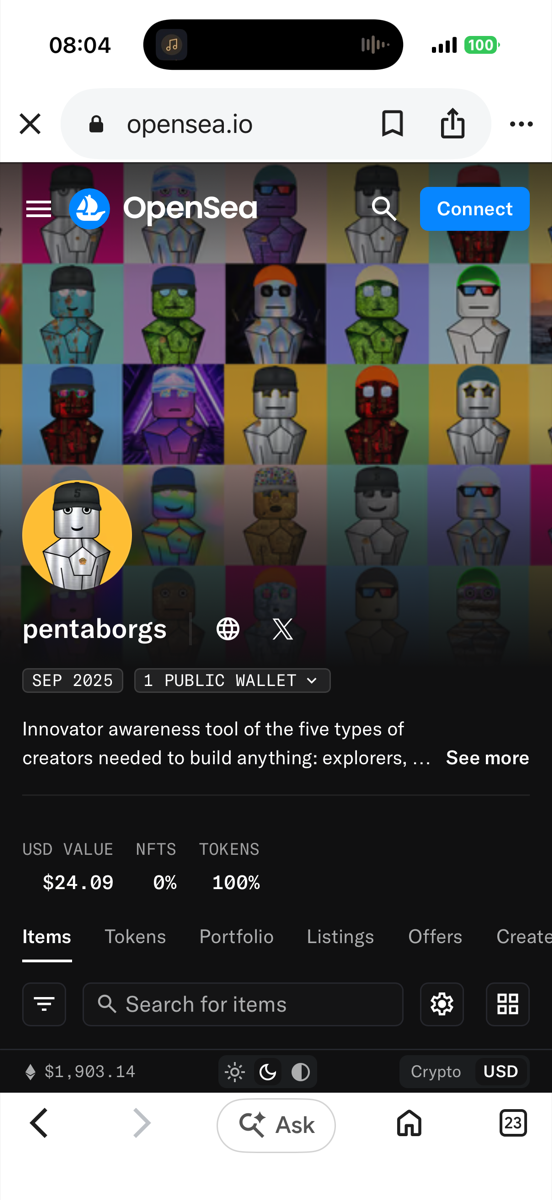
The art holds up. Blocky faceted humanoids with a pentagon chest plate and a pin, and real trait variety: caps in several colours, 3D glasses, star eyes, and body finishes running chrome, green camouflage, red mottled, rainbow iridescent, wood grain and speckled. The visual register sits between a CryptoPunk and a low-poly vinyl figure, which is a legitimate place for a physical object to live.
The market does not. The wallet reads a total USD value of 24.09, split NFTs 0%, tokens 100%. In plain terms the NFT holdings carry no market value and the collection has no secondary market.
That is not an argument against the idea. It is an argument against one specific version of it: any plan whose first customers are the 1,000 existing holders. The research fleet has been explicitly forbidden from falling back on them, and told to find a buyer who has never heard of the token.
The word "solopreneur" does not survive contact with the evidence
Yukai Engineering says on its own site that it is "a team of about 20 engineers and designers". It is a twenty-person Tokyo hardware company that crowdfunds each product because it has to buy tooling. Verified at ux-xu.com, and it is fatal to the framing rather than to the idea.
The stream then went looking for the thing you actually want, and could not find it: no verified single-person, physically-fulfilled hardware business making EUR 2,500 a month at low hours. Every genuinely one-person example sells files. Every physical example is two people, or twenty. That absence is itself the finding.
Eleven on-demand services were checked live. MOQ, tooling and inventory are all genuinely gone, exactly as hoped. What replaced them is labour, and no software removes it, because the thing that makes a pborg a pborg is colour, and there is no automated colour route at a consumer price point.
| Route | Colour | Cash cost/unit | Your minutes | Min retail at 60% |
|---|---|---|---|---|
| In-house FDM, single colour | none | EUR 10.40 | 14 | EUR 26 |
| In-house, colour body + printed accessories | most traits | EUR 12.00 | 19 | EUR 30 |
| In-house AMS multi-colour | all, poorly | EUR 19.20 | 16, and 3x machine hours | EUR 48 |
| In-house mono + you paint it | all traits | EUR 11.20 | 45 | meaningless: the cost is your afternoon |
| Bureau MJF, natural grey, qty 1 | none | EUR 54 | 13 | EUR 135 |
| Bureau MJF + colour dye, qty 1 | one flat colour | EUR 198 | 13 | EUR 495 |
| Bureau true full colour | all traits | EUR 132 (modelled) | 13 | EUR 330 |
| Slant3D drop-ship, US farm | none | ~EUR 35 to an EU customer | 0 | EUR 88 |
Read the two columns together. Every route that hits the automation bar either costs EUR 132 a unit or ships grey plastic from Idaho. Every route that hits the price bar costs you 14 to 19 minutes of handling, forever. The ODM route wanted EUR 25,000 to 45,000 of cash up front. The print-on-demand route wants roughly one working day a week, in a house in Castlebar, with boxes.
What the hours actually buy: at EUR 79 retail, EUR 2,500 of monthly gross profit is 53 units a month, about 12 to 13 a week, at 4 to 5 hours of your hands weekly. That is around 90 percent automated, not 99, and it has a hard ceiling near 25 units a week without hiring.
Bambu Lab P1S Combo EUR 529 and PLA at EUR 23.99/kg verified at 3djake.ie, 7 Aug 2026. 3D People UK published rate card verified: GBP 30 minimum order, and a GBP 120 colour-dye start-up fee that only amortises across a batch, which is structurally hostile to one-off orders. Slant3D Portals verified: free, no minimums, returns and support contractually absorbed, sub-36-hour ship, but US farms and single colour per part. Full-colour bureau pricing is modelled from a published USD 1 to 10 per cm3 band, not quoted: no vendor publishes a rate. Cost tables independently re-computed by a cold verifier.
Three honest phases, if you build the physical version:
- Build: 80 to 200 hours, once. Repairing and splitting a 47,000-triangle Blender mesh into watertight, support-free geometry a farm will accept, producing the variants, photography that converts, storefront, listings.
- Steady state if demand already flows: 6 to 12 hours a month. Ship nothing, restock nothing, answer nothing.
- Steady state in reality: 15 to 25 hours a month of marketing, indefinitely. A EUR 39 desk figure has no repeat purchase cycle and no institutional budget behind it. Stop marketing and the orders stop.
So the honest minimum is 15 to 25 hours a month, forever, after roughly 150 hours of setup. Not 10.
File licensing is the exception. Cinderwing3D has 7,070 paid members at an estimated USD 21,000 to 60,000 a month, selling printable models. Fulfilment is zero by construction and buyers get commercial rights, so they become sellers. The costs: a brutal power law in that niche, and you never control the quality of a physical pborg again.
Cinderwing3D member count and earnings band verified at graphtreon.com. Trade profit-and-loss figures for print farms verified as published, not audited: a five-printer UK operation shows GBP 13,000 revenue against GBP 3,500 of labour, with the warning that the commonest error is costing your own hours at zero. Self-printing to EUR 2,500 profit is a 40-hour week, roughly 16 times the stated budget.
1. The L&D buyer already sitting across the table. Zero acquisition cost, zero new market risk, uses the 5i framework where it is strongest, and the object prices as a rounding error on a fee the buyer already pays. It will not reach EUR 2,500 MRR alone. Treat it as the proving ground: if 5i-typed figures do not land with people already sitting in your workshop and already sold on the framework, they will not land anywhere, and you will have learned that for the cost of filament.
2. Corporate recognition and long-service awards. The best money on the list, and it satisfies all five of the graveyard's laws: institutional buyer, annual renewing line item, object works with no company alive behind it, one legible job. Verified budgets run USD 15 to 20 per year of service (so USD 150 to 200 at a ten-year milestone) and USD 200 to 350 per employee per year in total recognition spend. Blockers are procurement paperwork and an EUR 800 to 2,500 acquisition cost that only pays back at account level.
3. Certification and credential issuers. The one place print-on-demand is a requirement rather than a compromise, and the only one with genuinely recurring per-graduate revenue. Weakest evidence of the three, which is exactly why it should be tested on your own AI Badge programme before pitching anyone.
Two to kill, and the second one will sting
Designer and art toy collectors: kill today, without a test. The verified USD 159 art-figure price is paid for the artist's name and the scarcity of a drop, neither of which you have or can buy, and made-to-order destroys the scarcity the category runs on.
Consumer personalised gifting: kill second. This is the one instinct reaches for, because the market is around USD 33bn and the comparables sell at USD 88.88. But at EUR 20 to 45 acquisition against a EUR 60 order, with a grey printed robot competing against hand-painted likenesses at the same price, it is a negative-contribution business that also breaks the automation target through sheer support load.
Corporate recognition budgets verified verbatim at BI Worldwide and O.C. Tanner. Custom bobblehead comparables verified at figurebobblehead.com. A cold verifier corrected two arithmetic errors before publication: segment 2's revenue floor was stated at EUR 34,000 when the report's own inputs give EUR 17,000, exactly double, and segment 1's unit floor was 300 when 20 sessions of 12 participants is 240.
Legally, you are probably clear. Law firm Schoenherr states that the "vast majority of NFTs convey zero intellectual property ownership": absent an explicit licence, a token buyer acquires the token, not the copyright in the artwork. Since the 2022 mint published no licence, the characters remain yours to reproduce. Worth a solicitor's hour before anything ships, not a research report's confidence.
Commercially, the phygital wave is over. Nike sold RTFKT to an undisclosed buyer in December 2025. Funko shut Droppp entirely, with accounts disabled 31 May 2026, though it is honouring physical redemptions. Art NFT traders fell 96 percent, from 529,101 to roughly 19,575, and art volume fell 93 percent from USD 2.9bn to USD 197m. Total NFT sales were USD 5.5bn in 2025 against USD 8.9bn in 2024.
The one that survived did it by not being about the token. Pudgy Penguins put plush toys in Walmart and Target, and even there the analysis notes the licensing "does not clearly generate value for the secondary market for the tokens themselves". The toys work. The tokens are irrelevant to why.
Verdict: sever it. Use the characters as character IP. Keep the chain as a quiet provenance backend if you ever want it, and never market it. Your buyers on every one of the top three segments are corporate L&D, HR and credential issuers, which is precisely the audience most allergic to a 2022 Polygon mint.
Schoenherr, RTFKT, Funko Droppp, DappRadar trader and volume figures all independently re-verified. One statistic was struck before publication: a claim that "96 percent of collections show no meaningful trading activity" was traced to a source that does not carry it, and appears to be a conflation with the separate 96 percent art-trader decline. The argument holds on the verified figures alone.
The 30-minute experiment that could flip all of this
Every full-colour price above is modelled from a published band, not quoted, because no vendor publishes a rate for full-colour printing. That single unknown decides whether the automated route exists.
Upload 3Dpentaborg.stl, hollowed to a 2mm wall with escape holes, to Shapeways (Nylon 12 Full Color), JLC3DP (Full-Color Resin WJP) and Craftcloud. Quantity 1 and quantity 25, shipped to Castlebar. If a full-colour unit lands under about EUR 30, the verdict flips and the hands-free route becomes real. The odds are against it. It is still the cheapest question on this page.
Two smaller ones, an email each: 3D People on whether that GBP 120 start-up fee is indeed the colour dye, and the An Post calculator for real weight-banded rates at 400g to Ireland, the UK, the EU and the US.
07 What we actually hold
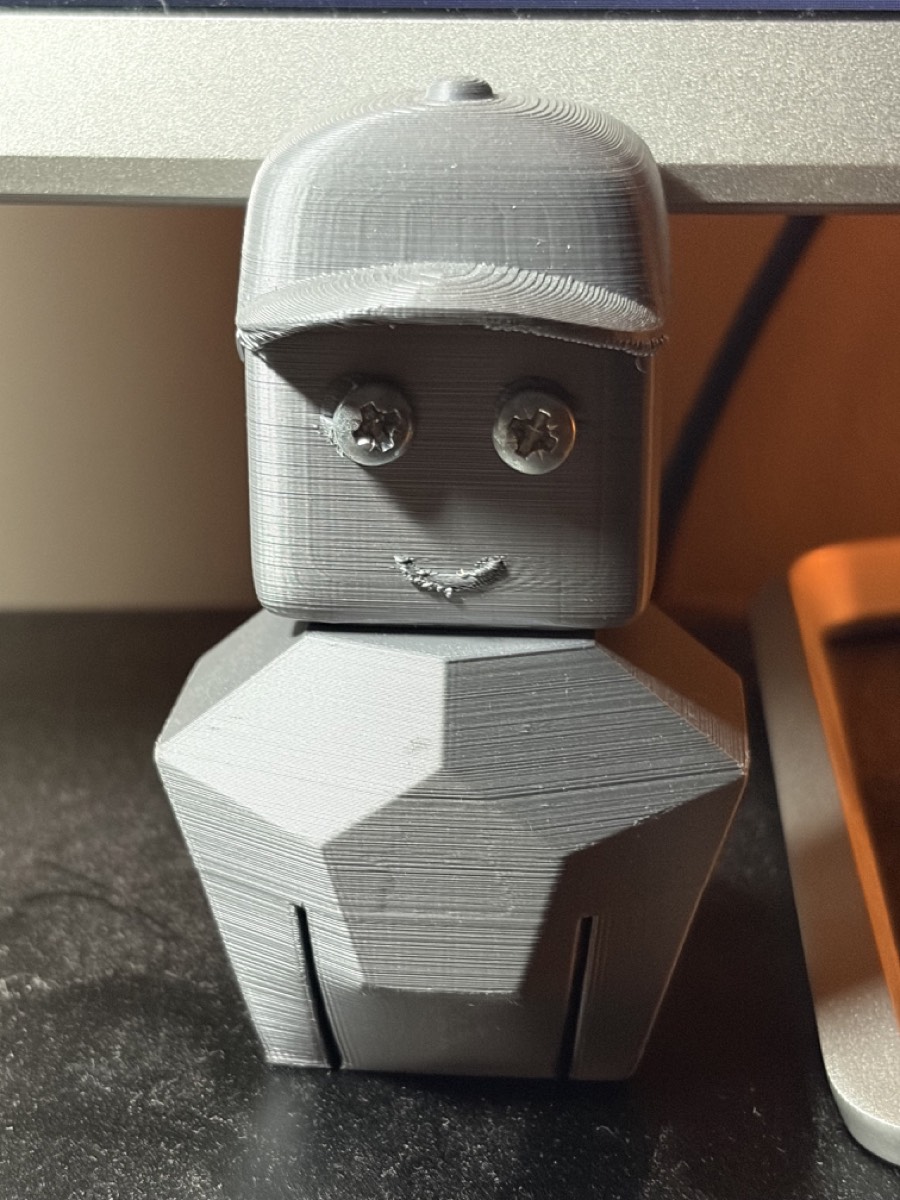
- The file is a Blender mesh, not CAD.
3Dpentaborg.stl, 2.36 MB, 47,172 triangles, header "Exported from Blender-3.0.0", dated 12 September 2022. No.step,.f3dor.3mfexists anywhere in the asset tree. - No supplier can quote from it. A mesh has no units, no tolerances, no wall thickness, no draft angles and no parting line. Every factory's first email will ask for a manufacturable file. A parametric CAD rebuild is line item one of any hardware path, not a detail to sort later.
- The proportions are the constraint. Bounding box 2.66 x 1.93 x 4.46 in Blender units: the figure is 1.68 times taller than it is wide and 2.31 times taller than it is deep. Scaled to a 100 mm figure that is a 60 x 43 mm footprint. Whether a battery, a speaker and a servo fit inside that envelope is a real engineering question, and it decides whether the design language has to change.
- The print itself is hobby FDM. Grey PLA, roughly 0.2 mm layers, visible seam stringing on the torso, support-free angular geometry on the head. That last part is genuinely good news: a faceted form with no undercuts is friendlier to both printing and moulding than a rounded organic one.
Irish application 267597, "Pentaborgs", filed 1 September 2022 in Class 28 (toys) and Class 41 (education and training). Examined, accepted, and advertised in Journal 2476 on 9 November 2022. Then withdrawn on 28 June 2023 under Section 45(2) of the Trade Marks Act 1996, which is what happens when the registration fee goes unpaid after acceptance.
Two consequences. First, there is no live mark today, so any plan that assumes brand protection is assuming something that does not exist. Second, the 2022 examination went through cleanly, which is decent evidence the word mark is registrable. Refiling costs EUR 70 per class plus EUR 177 on acceptance, so roughly EUR 317 for two classes across seven to ten months.
Verified against the IPOI eRegister on 27 July 2026. The Section 45(2) cause is inferred from the statute and the dates, not stated on the record.
A research run on 27 July 2026 mapped 137 uses for the dormant Pentaborgs asset. The highest-scoring one was not a product at all: a 45-minute facilitation instrument run at leadership offsites, sold to the EU AI Act Article 4 clients Victor already has. Zero manufacture, zero certification, zero inventory. A pilot email for it is written and sitting unsent at c1-pilot-email.md.
That matters for intellectual honesty. Any robotics recommendation this run produces has to beat a zero-capital option that could start this week, and beating it is not assumed. If the answer at the end is "the instrument still wins", that is a real finding and it will be stated plainly.
08 Landing next
Still to publish
Three sections remain from the research fleet, held back until their audited defects are repaired: the full supplier scan across Asia ODM, EU and Ireland near-shore and additive bureaus; the eight costed niches with named buyers; and the regulatory gate map with three-tier unit economics at 100, 1,000 and 10,000 units.
Two of the defects are serious enough to be worth naming now. A break-even calculation double-counted EUR 7.81 a unit, so the real figure is about 344 units, not 281, at the price the report actually recommends. And the connected-device compliance case was billed against EU radio-equipment cybersecurity rules that get repealed on 11 December 2027 and folded into the Cyber Resilience Act, so a 2027 or 2028 launch faces one gate, not two.